What is the best way to practice? The Mindset
Before we talk metronomes and scales, let’s get your brain in the right gear.
🧠 Practice With Full Concentration
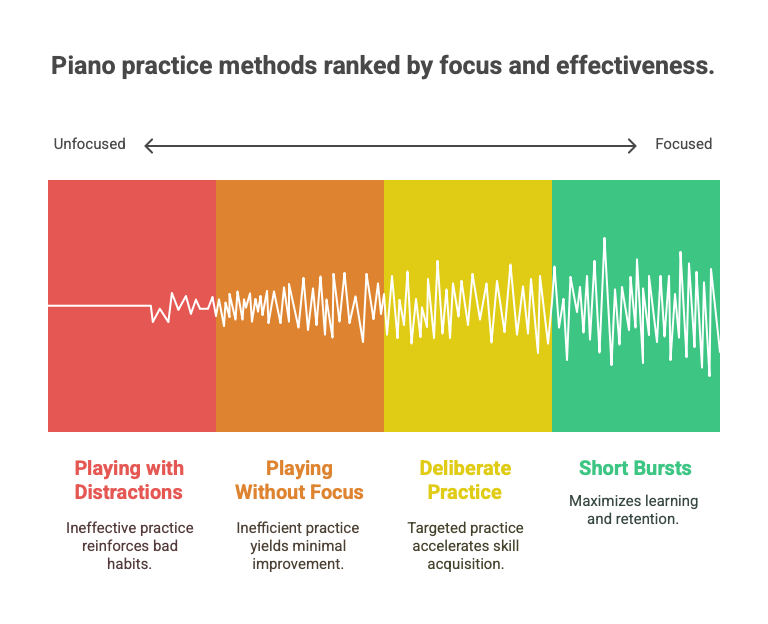
Playing piano while mentally planning dinner? That’s not practice — that’s background noise. The Liverpool Academy of Music puts it bluntly: “If your practising technique does not have your full attention, then you’re not practising properly.”
In other words, distracted practice is worse than none at all. It’s how bad habits sneak in wearing tap shoes.
Pro tip: Set a timer for 25 minutes, put your phone on airplane mode, and dive in with monk-like focus. You’ll get more done in 25 focused minutes than in 2 hours of half-scrolling, half-playing.
✅ Set Clear, Achievable Goals
“Play better” is not a goal. “Fix the rhythm in bars 17–20” is.
Enter: deliberate practice. It’s not about slogging through a piece from start to finish. It’s about targeting exactly what you want to improve — then drilling it with sniper-like precision.
A weekly written plan with specific checkpoints works wonders. Tick them off as you go. Satisfaction guaranteed.
😌 Stay Relaxed and Musical
If you’re gripping the keys like they owe you money, it’s time to reset.
One pianist put it beautifully on Reddit: “Focus on making music, not just playing notes. Your hands and mind should remain relaxed during the process.”
Tension leads to injury, stiffness, and robotic playing. Relaxation — both mental and physical — leads to artistry. Breathe. Soften. Make it sing.
🧪 Science-Backed Practice Strategies
Practicing isn’t just an art. It’s a science. And the smartest pianists use proven techniques to get more done in less time.
🔍 Deliberate Practice: The Secret Sauce
This concept is everywhere — from top conservatories to Olympic training. Why? Because it works.
Deliberate practice is structured, goal-oriented, and just outside your comfort zone. You don’t just repeat what you know. You focus on what you can’t do — yet — and fix it.
How to do it:
Set a specific goal
Break it into bite-sized actions
Focus like a laser
Get feedback (from a teacher or yourself via recording)
Push slightly past your current ability
🔁 Interleaving & Spaced Repetition
Instead of slogging through scales for 30 minutes, then your piece for another 30, try this:
Mix them up. That’s interleaving — switching between different tasks mid-practice. It keeps your brain alert and creates stronger learning connections.
Now add spaced repetition to the mix: revisit material regularly, with breaks in between. It taps into the “forgetting curve” — and turns it into your secret weapon. Re-learning solidifies your memory like glue.
It’s like strength training for your neurons.
🔗 Chunking: Zoom In to Zoom Out
Forget running the whole piece top to bottom every time. You’ll just reinforce mistakes.
Instead, chunk your music: break it into tiny, logical sections. Practice one chunk. Then the next. Then stitch them together with one overlapping note.
This is how concert pianists master monster pieces — one strategic step at a time.
🎹 Essential Piano Practice Techniques
Now that your brain’s primed and your strategy is airtight, let’s dig into the nuts and bolts of daily practice.
🔥 Start With Warm-Ups
Would you sprint without stretching? Neither should your fingers.
Begin with gentle stretches, then move into five-finger scales, arpeggios, or technical exercises like Hanon. It preps your hands, clears your head, and eases you into focused work.
🐢 Slow and Deep Practice (a.k.a. the Ninja Move)
The #1 way to master tough passages? Slow. It. Down.
Dedicate 40 out of 60 minutes to slow and deep practice — the kind where you:
Isolate a tricky passage
Play it at half-speed with full control
Only increase tempo when you can play it perfectly
It’s counterintuitive — but it gets you faster, faster. Because speed built on shaky foundations is just chaos in a tuxedo.
🛑 Don’t Ignore Mistakes
Hear a slip and think, “Ah well, I’ll get it next time”? Think again.
The Liverpool Academy of Music warns: “Little mistakes become hard-to-break habits.” That’s how bad habits become lifelong quirks.
Stop. Zoom in. Fix it. Then play it correctly three times in a row. Only then do you move on.
📍 Practice Short Passages With Intensity
Trying to play all 47 bars of your piece every day? Stop.
Pick one section and become its master. Like, sensei-level. Once you own it, move to the next. Then link them together like pearls.
It’s less overwhelming, more rewarding — and actually gets you to the finish line faster.
👀 Make Time for Sight Reading
Even five minutes of sight reading a day pays off in droves.
Why? Because it improves your rhythm, your reading fluency, and your overall musical IQ. It’s like compound interest: the more you read, the easier everything else becomes.
⏱️ Time Management for Maximum Results
Let’s face it: nobody has unlimited hours to practice. But you don’t need them.
⌛ The 60-Minute Power Practice Structure
Here’s a gold-standard hour-long session breakdown:
5 mins: Warm-ups (scales, Hanon, stretching)
10 mins: Sight reading or technique focus
40 mins: Deep, deliberate practice on your current piece(s)
5 mins: Fun — improvisation, playing for joy, or revisiting old faves
No wasted minutes. Maximum gain. Boom.
📈 Quality > Quantity
Repeat after me: “More time ≠ more progress.”
Greene Music says it best: “A 20-minute piano practice session with focused attention and an outline of what you will be practising can be far more effective than an entire hour of jumping around.”
Think of it like going to the gym. If you spend the whole time wandering between machines, you won’t get strong. But a 20-minute targeted workout? Game-changer.
🔙 Try Backwards Practice
Always start at the beginning of your piece? Try reversing it.
Backwards chunking means you learn the last few bars first, then the section before that, and so on. It’s a brilliant way to avoid the classic trap: nailing the beginning and botching the ending.
Plus, by the time you reach the start, you’ll have the whole piece ready to roll.
🧩 Bonus Tips That Actually Work
📹 Record Yourself
Cringe at hearing your own playing? Good. That means you’re learning.
Recording your practice reveals things your brain tunes out in the moment — uneven tempo, awkward transitions, missed dynamics. It’s the fastest route to self-awareness (and improvement).
🗓️ Be Consistent
Cramming the night before a lesson? That’s school energy.
Instead, aim for daily practice — even if it’s just 15 minutes. Piano progress is compound: small, regular deposits beat erratic windfalls every time.
🧘 Have Patience and Perspective
Some days, everything clicks. Other days, you’ll feel like your fingers forgot how to human.
That’s normal. Progress isn’t linear — it’s a messy, glorious tangle of breakthroughs and plateaus.
Trust the process. Keep showing up. The magic is in the doing.
🎉 Final Thoughts: So, What is the Best Way to Practice the Piano?
Focus deeply. Mindless practice = wasted time.
Set goals. Know what you’re fixing before you start.
Warm up. Don’t skip it. Your fingers will thank you.
Practice slowly. Precision first, speed later.
Break it down. Master small sections and stitch them together.
Use scientific methods. Interleaving, spaced repetition, and chunking work wonders.
Make it regular. Small, daily doses beat long, erratic ones.
Keep it musical. You’re not a robot. Make music, not just sound.
Whether you’re aiming to ace your Grade 8, serenade the living room, or just finally conquer that Chopin prelude, the way you practice is everything.
Now go. Sit down. Practice like a scientist. Play like a poet.
If you’re ready to stop wasting time and start practising with real purpose, my live one-to-one online piano lessons can help. We’ll apply all the techniques from this guide — chunking, slow practice, goal-setting and more — in a way that’s tailored to you. Click here to learn more.
Interested in online piano lessons?
FAQ: Mastering the Art of Effective Piano Practice
1. What’s the single biggest secret to practicing piano effectively?
It’s all about quality over quantity. Full concentration and clear, achievable goals transform your practice from mindless banging to real progress. If your mind drifts, hit pause and come back when you can focus 100%. Practicing smarter beats practising longer every time.
2. Why should I slow down when practicing difficult pieces?
Slow and deep practice is the ultimate game-changer. Playing tricky passages at a snail’s pace with total control builds muscle memory and understanding way faster than rushing through mistakes. Nail it slow, then speed up — it’s the secret sauce to playing fast and flawless.
3. What’s this ‘chunking’ method everyone talks about?
Chunking means breaking down intimidating passages into bite-sized, manageable sections. Instead of tackling a whole beast of a piece, you laser-focus on one tiny “chunk” at a time — fixing trouble spots with precision, then seamlessly connecting the dots. Efficiency meets mastery.
4. How important is warming up before practice?
Vital. Think of it as stretching before a workout. Warm-ups loosen your fingers, improve dexterity, and prevent injury — setting the stage for focused, productive practice. Skipping warm-ups? That’s like jumping straight into a sprint with no prep — recipe for tension and frustration.
5. Can mixing different skills during practice really help?
Absolutely. Interleaving—switching between scales, sight-reading, and pieces—keeps your brain sharp and stops boredom dead in its tracks. Plus, it strengthens your memory by spacing out learning. Trust the science: mixing it up is a major boost for fast, lasting progress.